
No products in the cart.
Maria Hadiji – History, Museography, and Contemporary Art
In recent years, a distinctive voice has emerged on the Romanian visual arts scene: Maria Hadiji, a multidisciplinary artist who combines painting, ceramics, and sculpture with a strong background in history and museography.
Born on June 30, 1975, in Topleț (Caraș-Severin, Romania), Maria Hadiji graduated from the Faculty of Letters, Philosophy, and History at the West University of Timișoara, earning her degree in History in 2002, followed by master’s and doctoral studies. She worked as a teacher of history and civic culture between 2002 and 2006, and since 2006 she has been active in the museum field. She first coordinated activities at the Banat Museum in Timișoara, and since 2011 she has served as a curator and Head of the Exhibition Section at the Banat Village Museum in Timișoara.
Her path toward painting and sculpture began later, in 2017, when she enrolled at the School of Arts within the Center for Culture and Art of Timiș County. Although she had enjoyed drawing since high school, it was only then that she decided to explore artistic creation seriously.
After graduating, she was admitted to the Faculty of Arts and Design at the West University of Timișoara, initially specializing in ceramic design. Following a program restructuring, she continued her studies within the broader field of Sculpture – Ceramics, where she discovered the world of three-dimensional forms. This experience profoundly reshaped her vision of artistic creation. Working alongside remarkable professors and established artists, she developed a new understanding of art as both a practice and a philosophy of life.
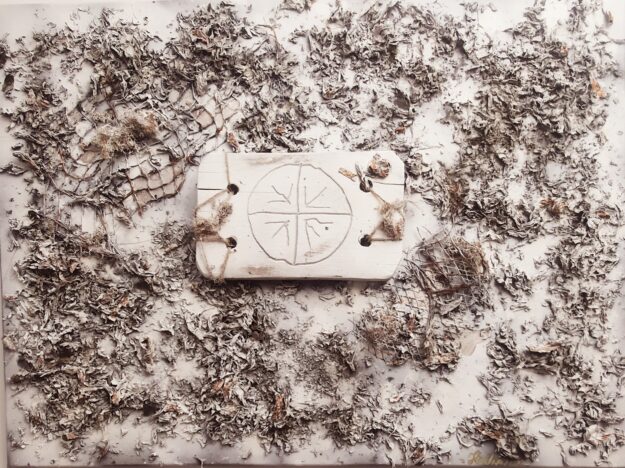
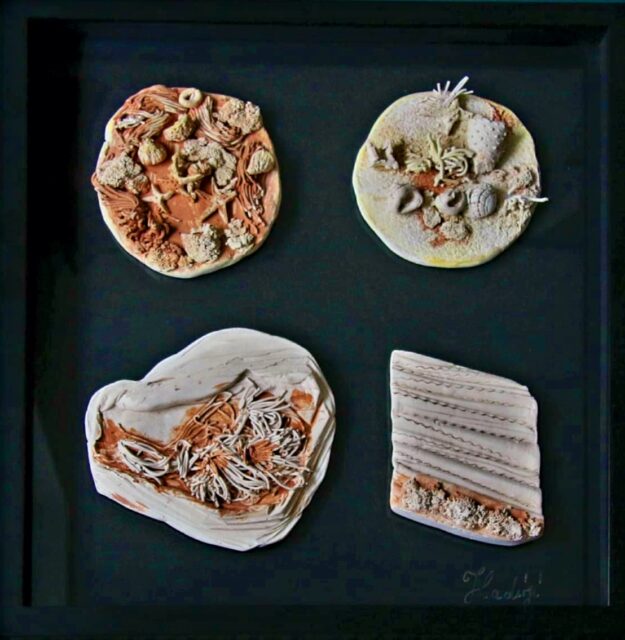
Hadiji’s professional work as a museographer has been closely tied to Banat ceramics. At the Banat Village Museum, she studied traditional pottery centers in the region and worked on cataloging and publishing specialized studies. This background has given her artistic practice both historical depth and cultural resonance, enriching her exploration of clay, sculpture, and installation art.
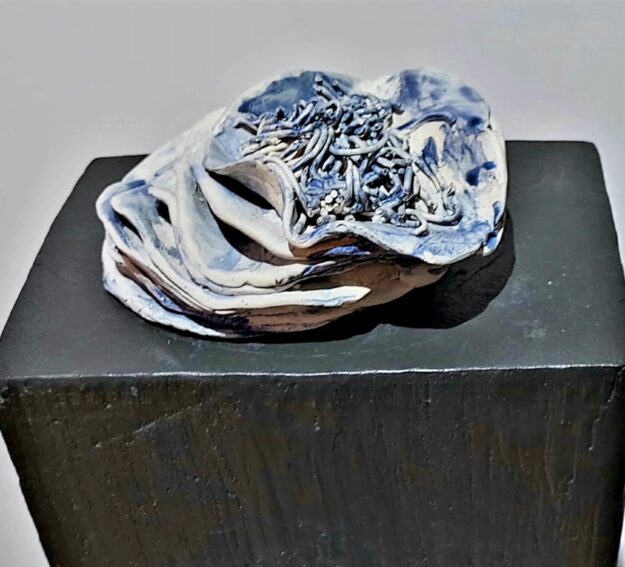
Her painting is defined by acrylic on canvas, pouring techniques, and mixed media, while her sculptural work often takes the form of ceramic modeling, object sculpture, installation, and land art. The balance between theoretical research and hands-on creation allows her to approach art both as an act of preservation and as a process of innovation.
Since 2017, Maria Hadiji has participated in over 47 group, collective, and solo exhibitions in Romania and abroad. Her first solo exhibition took place in 2020, followed by several other projects that highlighted her versatility across mediums.
In 2021, despite the challenges of the pandemic, she remained active both in physical and online exhibitions, including Chromatic Dialogues between Serbia and Romania, held at the Vršac Cultural Center, and her solo show Autumnal, organized in an unconventional venue in Lugoj.
Her efforts were further acknowledged in 2022, when she received an award for mixed media at the International Exhibition of Visual Arts “Zis și Făcut”, organized by the Romanian Union of Visual Artists, Iași branch.
For Hadiji, creation is more than expression—it is transformation. She describes herself as a sensitive, imaginative, creative, and persevering spirit, constantly inspired by the world around her: people, gestures, attitudes, and nature.
“Creation is nothing but the materialization of something that had neither form nor color before,” she reflects. Her works embody this philosophy, filtering the external world through a deeply personal lens and releasing it into forms filled with color, energy, and emotional charge.

Nano Banana free
What a delightful read! Maria Hadiji truly embodies the spirit of becoming a Home artist, blending history, museography, and a whole lot of creativity. Its fascinating how she transitioned from teaching civic culture to exploring the world of three-dimensional forms and art as a philosophy of life. Her journey from ceramic design to mixed media painting and sculpture is quite the process of innovation, wouldnt you say? And who knew Banat ceramics could be so influential? Her work seems like a perfect Exhibit with us opportunity. Though her description, Creation is nothing but the materialization of something that had neither form, might just be her way of explaining the occasional Summer Salon 2025 surprise!Nano Banana free