
No products in the cart.
Georgia Houry: Between Memory, Body, and Cultural Inheritance
“I navigate between cultures, languages, and traditions. This movement has shaped my identity and my artistic vision.”
Georgia Houry was born in 1975 in Athens to a Cypriot Lebanese father and a French Hong Kongese mother.
Her upbringing unfolded across cultures, languages, and geographies.
This early exposure shaped her sense of self.
She now lives and works in Cyprus, where motherhood and place remain inseparable from her practice.
As a mother of three daughters, lived experience is not referenced. It is embedded.
Her work begins where daily life leaves its mark.
Houry holds a BA in Psychology and an MA in Fine Art from Falmouth University.
Her academic background informs how she approaches image making.
Psychology sharpens her attention to memory, trauma, and inner narrative.
Art becomes a method of inquiry.
The studio mirrors an analytic space where reflection drives form.
Each work functions as a site of investigation.
“I am fascinated by the complexity of human experience and the inner narratives we carry.”
Her practice spans painting, drawing, mixed media, video, and writing.
She works primarily in figurative and representational forms.
Graphite, charcoal, watercolour, oils, and layered materials shape her visual language.
The body appears fragmented, repeated, or suspended.
Gesture holds meaning.
Resolution remains absent.
Feminist and confessional frameworks ground her work.
She examines womanhood through lived experience.
Motherhood appears as care, exhaustion, intimacy, and rupture.
Generational narratives surface through repetition and absence.
Personal history remains visible.
It resists idealization.
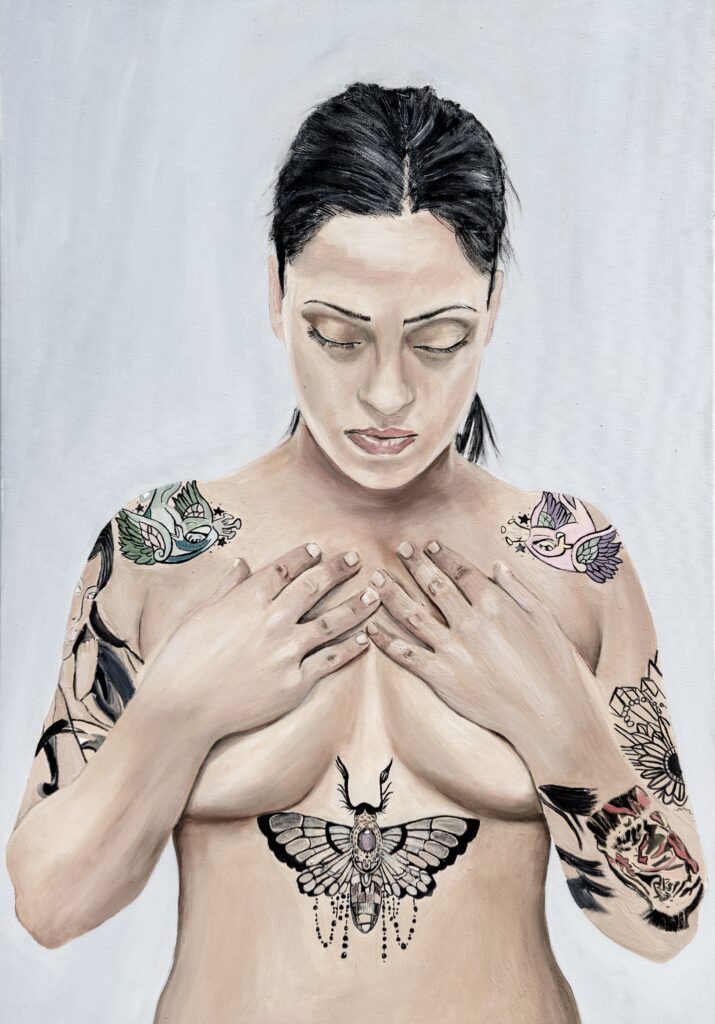

“My work reconstructs personal narratives that resonate with shared human concerns.”
Cultural hybridity shapes both content and structure.
Her work navigates belonging and displacement.
Autobiography merges with archetype.
Individual memory opens into collective recognition.
Writing enters as both influence and parallel practice.
Text deepens confession and extends the voice.
“Writing allows me to access layers that images alone cannot hold.”
Houry’s work offers a space for recognition rather than spectacle.
Vulnerability appears without performance.
The viewer enters quietly.
Art becomes a process of self discovery.
It also becomes an act of connection.
The human condition remains layered, unresolved, and shared.
Georgia Houry’s practice continues to evolve through sustained introspection and material exploration.
Her work does not seek answers.
It holds space for ambiguity.
Each piece functions as a record of presence and attention.
Through image and text, she traces how identity forms, fractures, and reforms over time.
In doing so, she affirms art as a necessary site for listening, witnessing, and shared recognition.
Leave a reply